There are six entrances into Dizengoff Square. The square in the shape of a circle, really, so I don’t know why in English it’s named after the four-s`ided shape. It’s a big square, at that, bigger than standard ones in Israel, known as a cultural and social touchstone in Tel Aviv, with cafés and bars and designer stores all around. But it isn’t massive. It’s big enough to hold a crowd of, I’d say, about 250 people, as it did last Wednesday evening on Yom Kippur when folk, all in white, played cards and sat on blankets and passed the time before they could eat and drink again. But it’s small enough that a moderately athletic seven-year-old could probably throw a tennis ball the length of its diameter.
I arrived at the square by foot, which explains my ensuing predicament. By car, in the two-lane roundabout, I would have known the rules. You head right as you enter, merge with the movement, and indicate where you intend on getting off (though this is Israel so good luck witnessing anyone using their indicator). But after I crossed the road, climbed the couple of steps, walked past the rectangular artificial grass lawns people sit on, and reached the “Fire and Water” fountain at the square/circle’s center, I didn’t know which way to turn. Logically, we’d all be walking right, with traffic, but a brief look at the crowd indicated that people are going in all kinds of directions.
I opted to go left, not for some symbolically ideological reason (though I am, as the kids would say, a whore for conveniently narrativizing my own life). There was just more space in that direction at that particular moment.
Under normal circumstances, people sit on the cemented ledge of the fountain, the water slushing behind them emitting a faux, light breeze. But yesterday, and for the last two years, there was no room to sit on the ledge as, even by Israel standards, these are not normal circumstances. The ledge was filled—and I mean Filled, not a single cubic inch of cement visible—with photos, and candles, and stickers, and posters, and signs, and pleas, and hats, and shirts, and beer bottles, and a single notepad by a military burial stone, and other memorabilia by which a singular person can be identified or remembered—some idiosyncratic item that, when pressed to explain, a loved one could say, That was their thing, so that a regular old person from the street, strolling through whatever entrance, while incapable of grasping the full humanity of that person, could at least begin to grasp how those who loved them have tried to formulate a shape of the memory of that humanity after they were gone. And that is what we tried to do.
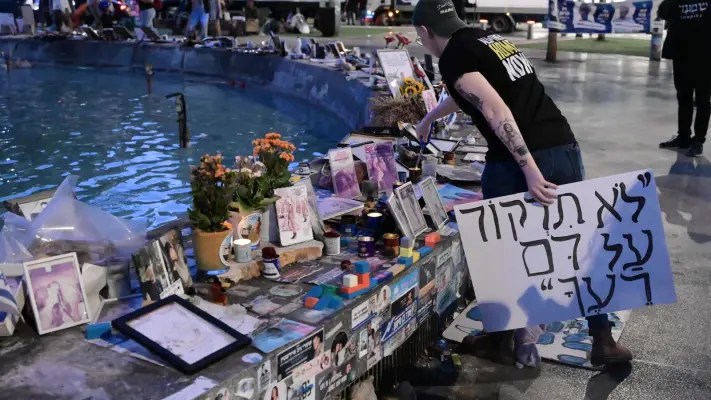
While a few of the picture frames included song lyrics, and a handful had a few sentences about who the person was, the vast majority of frames simply held the photo and the person’s name written in black marker. So, as I began ambling left, I wasn’t really sure what to do. What am I to do with this information: a face and a name. Then, moving my eyes perhaps three inches in any direction, another face and another name. Zooming my eyes out a bit, seeing seven more faces and seven more names. Looking at the bigger picture and understanding less. Each person in a frame their own story, their own grieving mother or father or child or sibling or friend or all of the above, each their own world that collapsed or shattered or was swallowed whole, each leaving their own ever-expanding black hole of a life no longer lived, no memories to make or paths to go down or card games to play, impossible to forget, yet, there on that circular slab of cement, easily lost amidst all the other faces and names.
How was I to go about accessing this, whatever this is, was what I thought. And it is perhaps that verb, thought, that was the issue. That was not the place for thinking. So, I walked.
I walked, and I read one name after the other, and I did my very best not to miss any. Not for any particular reason: perhaps simply out of a compulsion to do some due diligence, perhaps as a way to feel like I’m paying my respects, perhaps because I was looking for something specific. Someone. Many were recognizable. Faces and names whose stories we know—whether they were murdered in their homes or while called to serve or with trance music in the background; faces and names pasted on traffic light poles and benches and walls and stores and every single other sliver of space in this country where there is space to remind, lest we forget, that 48 of them are still there. Oh, he’s the one who, Oh, she’s the one who. And now we’re the ones with the duty to remember. As many as we can. And yet, despite how many we know, there are still so many we don’t. So, I walked.
I walked and I saw a frame holding a selfie of an old lady on her couch at home, the kind that if my grandmother would have posted on Facebook, I would have cringed. Except that this selfie in a frame was on a circular slab of cement, and so it made me cry. I saw a frame holding two photos side-by-side and heard a family of four ask why these two were put together, then someone answer that it was probably because “They were murdered together.” I saw a bottle of Corona resting on the corner of one frame, and I tried to imagine the joyous memories that this idiosyncratic thing is built upon. I saw that some frames had names only in Hebrew, some included English, and some included Arabic. I saw a woman walk with a bag of a hundred Yahrzeit Candles, which is a phrase I don’t like using because in Hebrew we say Soul Candles and that feels much more apt, but I know that some people who will read this are not from Israel and so they need me to explain, because when you are not from here, it is nearly impossible to understand.
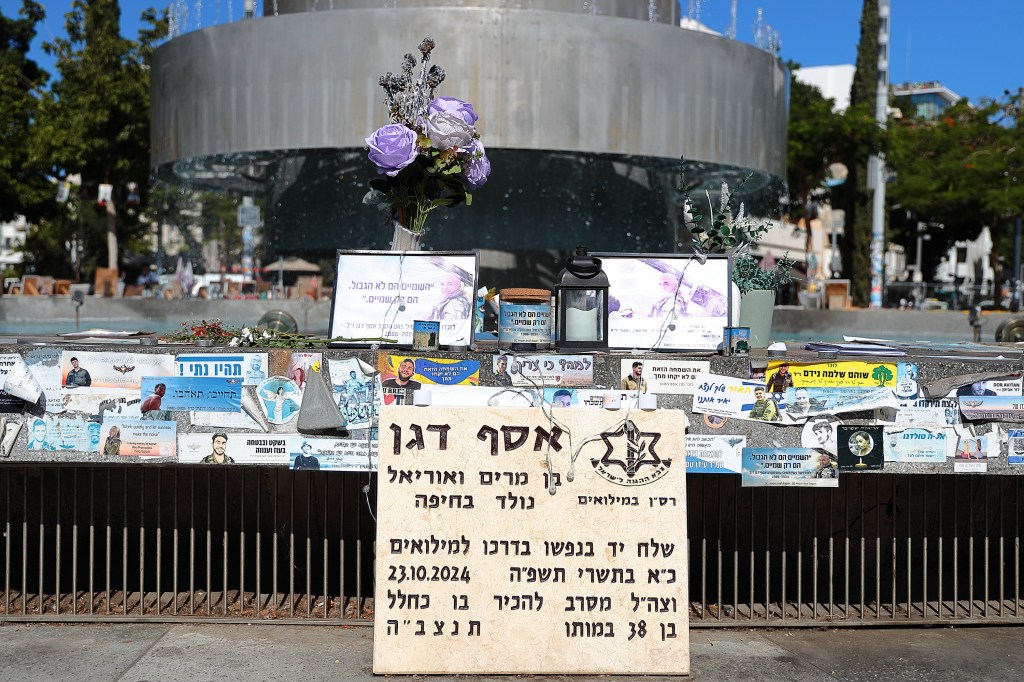
I saw a military burial stone, the kind of which I could recognize from a mile away because everyone here can, with the trademark font and IDF logo. Except that this one was slightly different. It was in memory of an air force navigator who, after serving in reserves for 190 days over the course of the war, on his way to another stint of service, took his own life. The army refused to recognize him as a fallen veteran. The family appealed to the supreme court, and a compromise was reached: his funeral was held in a military ceremony, but his body was buried in a civilian one. Was he a soldier or was he a person or was he both or was he neither? I would guess that for those who loved him most, all that matters is that he no longer is, but was.
Above the stone was a notepad and pen with the instruction to write messages of remembrance in his honor. I stood there staring at it for a while trying to figure out: What am I to do with this. What could I possibly say.
I saw a man using a lit candle to light a candle that’s flame blew out, and I wondered which would make for a better narrative: A single flame going around lighting up the world around it, or countless sources of light going to the same place to be sparked. Perhaps the direction doesn’t matter. Perhaps all that matters is that the world would end up being filled with light.
I saw the woman with the bag of Soul Candles stopped in front of something, someone. I saw that she was crying, so I started to, too.
I stepped backwards to let people walking quicker go past, and I side stepped when I and whoever was coming from the other direction stopped by the same sliver of cement.
I moved out of the way of an American woman who was walking right along the edge, recording a video of the circle on her phone. I do not know where she started, but her screen indicated that she’d been recording for one minute and 44 seconds. She walked on and I imagined her posting that video on Facebook or showing it to friends at a dinner table while uttering the phrase, “Look how it just keeps on going.”
And it was at that point that I couldn’t help but think about the question that I didn’t necessarily feel pressed to ask but that did bounce around in my head as a question that a lot of people I know would ask: For how long would the circle keep on going in Gaza?
It is an inextricable question, yet also one that exists on its own plane. It is a question I cannot walk but I feel compelled to acknowledge. It is a question that shapes how the world views this country, but not necessarily how this country views itself. Certainly not on this day. It is, perhaps, a question I have the privilege to postpone.
A part of me felt disdain for that recording woman’s need to document—rather than experience—this, this thing. This scene and setting and context and plea and pain and grief and sorrow. This thing that can only ever be felt in the time and moment in which it transpires, and any act that attempts to recreate it should be considered a disservice to its purity. Then again, here I am. Doing exactly the same.
I also took one picture. It was of a man who was a Liverpool fan and whose mother, father, sister, and nine-year-old nephew were all kidnapped into Gaza. My mother went to his funeral. I figured that she would want to see the photo, despite the fact it would undoubtedly make her cry. As of writing this, I’ve not yet sent it to her, because I still don’t understand why all of us here have an urge to consume and document and share all this stuff that makes us cry. And yet, I know I should. Because if I don’t send that picture to someone who I know would sink into the abyss just by the mere sight of it, then the small part of this day and this country that I have the power to keep in our collective memory will be forgotten. And this country is predicated on the very idea that we will never forget. That forgetting will signify a dissemination of the foundation upon which we are built, leading to our fall. So perhaps that is why we walk out of our homes and go seek out places and people and moments and photos that will burden us and break us and scar us, never even taking the time of day to consider how that scar tissue could heal, or what the wound could infect.

The photo I took is nothing more than a face and a name in a brown wooden frame, yet at the same time it encompasses everything about why this day, every year, will signify everything about what this country now is. The horrors endured and those overcome. The 48 people still there. The unprecedented feeling of loss: not just of life, but of identity, of a ground to stand on. The sense of abandonment by those whose job it was to protect and lead, and the sense of solidarity from those who never asked to but that couldn’t help but fight and save. The trauma of that morning: a nation watching, in real time, on TVs and phones, from shelters and safe rooms, the things they were taught to never forget: murder, and fear, and terror, and evil. Things that people who grew up here were told happened to us decades ago, but never again. Things that Israelis could never fully comprehend because they never experienced them. Until this day, two years ago.
And maybe that is why that woman recorded that video, and maybe that is why I wrote this thing. To do our bit of remembering despite how pointless it could feel. Because it is impossible. It is impossible to do justice to what it’s really like.
It is impossible to convey the weight and depth of faces and names; faces and names you undoubtedly know somehow, and which, by derivation, this country remembers. Faces and names, each of them landing on you like an invisible feather on your bare skin, their weight unnoticed for a time until it becomes unbearable, all of them suddenly prickling you at once, sending goosebumps up and down your arms, leaving you there, stone cold, with teary eyes and a tightened throat, trying to figure out what you’re seeing or what on earth you’re supposed to say, where you remain until, once more, you continue to walk.
Walk, realize that, much like this country, we are going in circles, adding faces and names with every step, growing dizzier with despair, forgetting where we started, and, perhaps more importantly, how on earth we’re supposed to get out.
 Eyal Cohen
Leave a comment